Supporting bees and beekeepers in Whitstable, Herne Bay, Faversham, and surrounding areas
Local apiary news
New storage shed at campus apiary
At long last, the branch has a proper storage shed at the campus apiary. There is now enough room for over-wintering equipment safely and even – we hope – a work area. All those members of the branch committee who have been patiently storing branch equipment in their garage, garden, house eaves, etc, can now reclaim their own space. 🙂
The warm spring weather we have been enjoying over the last couple of days has enabled most beekeepers to carry out a first inspection of their hives.
This is a time of excitement and trepidation for me, will the hives be thriving with plenty of young bees and a healthy laying queen or will the colony be dwindling to extinction, usually due to queen problems. I have bees at home, and in an out-apiary, and have experienced both of these with my colonies this spring.
One colony had old supersedure cells, where the old queen can be replaced by a daughter usually in the autumn. This had failed last autumn leaving a once thriving colony queenless, right through the winter and unsalvageable in the spring. I shook the few remaining bees out of the colony and hope they will find their way into adjacent hives if guard bees permit them. Textbooks tell us that supersedure is usually in the autumn, but today I found a colony attempting to raise a new queen. Only one sealed queen cell, pictured, was found, and the workers were attending to it. The two-year-old queen, also present, was in the hive with eggs and all stages of larvae present. Fingers crossed for her progeny, there are drones in other colonies which should be sexually mature, about 12 days old, before the virgin queen goes out on a mating flight. The presence of mother and daughter in a hive together is termed ‘perfect supersedure’. Fingers crossed for good weather for the next couple of weeks.
The sealed queen cell, in the middle of a patch of sealed worker brood
I put a first super onto a number of hives today, those with 5 or 6 frames of brood (14×12 nationals) and bees occupying all frames in the brood box. In one colony I was too late and on removing the roof found brace comb in the hole in the crown board, pictured. Removal of the crown board revealed nectar filled brace comb underneath, which of course broke and then became covered in bees supping their precious liquid gold. I cleaned this all away, put on a queen excluder and super and put the brace comb back over the crown board for the bees to eat or to take down and store. I will need to inspect this colony in a day or two as lack of space to expand is a sure trigger to swarming.
A couple of things to note from the pictures:
a) I like to keep my bees in hives with top bee space in the brood box as I find less bees are squashed during manipulations. In this case the bees made the brace comb in that extra space above the frames. If you use bottom bee space in your hives so the frames are flush with the top of the box, the bees will have no problem filling the space between the crown board and roof with comb. We do our best to be a step ahead but don’t always succeed.
Brace comb that had been built between the top of brood frames and the crownboard.
b) Many years ago I bought some second hand equipment, mostly brood boxes but a few other bits and pieces in the lot.
The crown board in the picture, part of that lot has had greater wax moth, and you can see the indentations where they are able to eat into the wood when they take up residence. Something to be avoided if possible and definitely in poly hives or nucs which can be completely destroyed by the wax moth pupae.
A crownboards showing the marks from a previous infestation of greater wax moth.
After a cold and wet winter, the start of the month has seen a week of warm and sunny weather. We have been tidying and organizing equipment for the coming season, planning the 2025 beginners’ course and contemplating queen rearing if the weather allows.
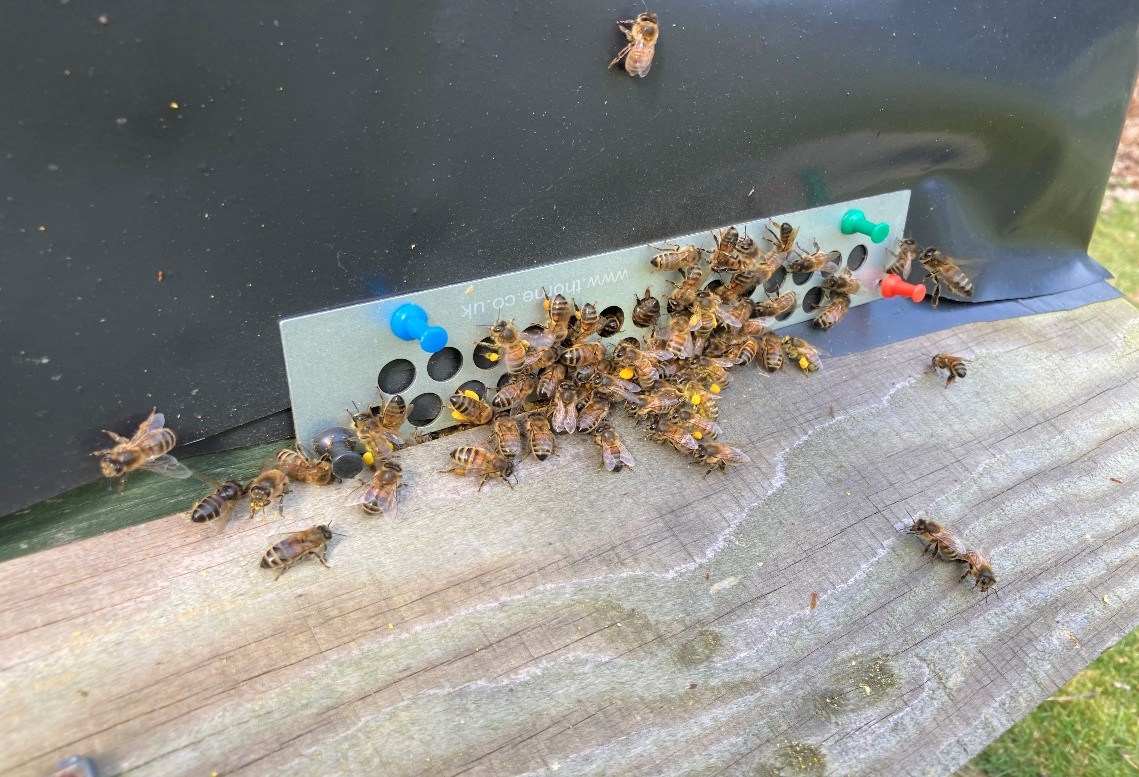
Bees are actively flying, and I’ve seen two types of pollen on worker bee legs, one bright yellow, the other a more mustard, dirty yellow. Mouseguards have been removed as these can knock the pollen off the pollen baskets as bees walk through, and that precious pollen is lost.
The apiary team continues to monitor fondant consumption and replace where containers are empty.
We have lost one colony unexpectedly at the Monks Hill apiary, and one which was known to be weak at the University. On hindsight, maybe this one should have been united in the autumn as it was small then, but it’s always risky uniting a hive that’s not thriving in case it has disease. Occupied frames have been removed and burnt, the remainer being sterilized using acetic acid.



 Whitstable & Herne Bay Beekeepers